

Soulcraft Musings
Today, January 20, 2017, we inaugurate Soulcraft Musings, a new offering from Animas Valley Institute (see below). This is the same day America inaugurates a new president, a cultural upheaval currently mobilizing thousands of response teams worldwide. On this day we commence our humble project of Soulcraft Musings in support of the deepening, diversification, and flourishing of all life. At this time in the world, may we all inaugurate actions and projects that collectively give birth to a life-enhancing society.
Friday, June 5, 2026
A Map to the Next World, Part VI
This is Part Six of a 20-plus-part essay on making and following a map that might get us to the Next World, and on what it means to leave one world and eventually reach another, and on what it’s like for a community or a society to be between worlds, perhaps walking that long road for several generations. Think of this as a draft of an essay I’ll be working on for a while — or eventually a short book. Let me know — through Substack — what resonates with you. To fully understand or contextualize today’s part, you might want to read, reread, or at least scan the first three parts. Link Below.
This multi-part Musing makes up my second posting on Substack. It would be great help in this launch if you would become a Free Subscriber. (You can use the “no pledge” option when you click on the link below and then “Continue without pledging.”) Join the community: Click Here. After you subscribe, do check your email (including spam folder) to confirm. Thank you.
Developmental Stage is Everything — Part Two
In my Substack posting last week, I introduced a soulcentric framework for maturation into true adulthood and elderhood, life stages reached through what I call nature-based full-spectrum human development (NB-FSHD), a natural process that has become quite rare in Dominator World. The Soulcentric Developmental Wheel is one component of our Animas model of NB-FSHD.
The Soulcentric Developmental Wheel was generated by projecting the stages of human unfolding onto three of nature’s holistic templates, namely (1) the four cardinal directions (more specifically, what anyone can observe and feel when facing the directions of east, south, west, and north, and noticing what is present and what takes place in that direction, including the rising (east) and setting (west) of the Sun and (for the Northern Hemisphere), the warmer-drier (south) or colder-wetter (north) side of trees, boulders, mountain slopes, buildings, and so on), (2) the four times of day (dawn, noon, dusk, and midnight) and their distinctive experiential qualities, complexions, and atmospheres, and (3) the four seasons (for those bioregions that have them) with their characteristic moods, tones, and flavors.
The Soulcentric Developmental Wheel identifies eight optimal, nature-based life stages — stage 1 beginning in the east and stage 2 (in the northern hemisphere version) in the southeast, etc., continuing in a clockwise direction [14] — and describes five aspects of each stage:
– the specific developmental tasks (two for each stage: one culture-oriented, the other nature-oriented; for example, in soulcentric middle childhood, these are, respectively, learning cultural ways — the social practices, values, knowledge, history, mythology, and cosmology of one’s family and culture — and discovering the enchantment of the natural world)
– the psychospiritual center of gravity (the realms of social, psychological, and spiritual existence that one’s life revolves around in that stage when it is soulcentric — for example, middle childhood unfolds equally within the realms of family and nature; in early adolescence: peer group, sex, and society; in late adolescence: the mysteries of nature and psyche)
– the human archetype and the Earth archetype most resonant with that stage (for example, the Wanderer and the Cocoon in soulcentric late adolescence)
– the gifts to the greater Earth community offered instinctually and inherently by people in that soulcentric stage (for example, luminous presence in early childhood, wonder in middle childhood, and creative fire in early adolescence)
– the nature of the passages from one stage to the next (passages that can be marked, celebrated, and supported by — not caused by — rites of passage) (for example, Soul Initiation is the passage between soulcentric late adolescence and early adulthood)
On the Soulcentric Developmental Wheel, there are two stages each of healthy childhood, adolescence, adulthood, and elderhood. The start of each stage has nothing to do with age, other than the fact that stage 1 begins at birth. When we transition from one soulcentric stage to the next, it is due to success with our development tasks. True maturation is an achievement, not a consequence of simply getting older. Each of the eight soulcentric stages were named for the partnership of one human archetype with one Earth archetype, namely (starting with stage 1): the Innocent in the Nest, the Explorer in the Garden, the Thespian at the Oasis, the Wanderer in the Cocoon, the Apprentice at the Wellspring, the Artisan in the Wild Orchard, the Master in the Grove of Elders, and the Sage in the Mountain Cave. The nine passages between the stages (each a type of initiation) are Birth, Naming, Puberty, Confirmation, Soul Initiation (e-niche-iation), Induction, Crowning, Surrender, and Death.
Although this is only a thumbnail introduction to the Wheel, the stage and passage names alone can give you a feeling for the psychospiritual terrain of nature-based full-spectrum human development. You can view a complete diagram of the Soulcentric Developmental Wheel here. [15]
Sometimes we refer to this life-stage model as the Ecocentric Developmental Wheel. What’s the difference? Soulcentrism is a special case of ecocentrism. To be ecocentric is to hold the greater Earth community (the ecosphere) as central in importance; this contrasts with both egocentrism (holding the individual self as central) and anthropocentrism (humanity as central). To be soulcentric is to hold the Soul as most important in human development and as the center of individual existence. If we understand Soul as an individual’s innate place or niche in the greater Earth community, then to be soulcentric is a special case of ecocentric. All human psyches are, at root, soulcentric but we are not consciously soulcentric until sometime in the Cocoon stage, during which the journey of soul initiation takes place and during which we have our first conscious encounter with Soul. All soulcentric humans and communities are ecocentric but not all ecocentric humans and communities are (yet) consciously soulcentric.
The unconventional nature of the soulcentric Wheel — its radical nonconformity with modernity — becomes evident just by contrasting the names of the ecocentric life stages with the names I felt compelled to use for the much more common egocentric stages endured in Dominator World, namely: Obedience and/or Entitlement Training (egocentric early childhood), Primary Socioeconomic Training (egocentric middle childhood), followed by six stages of egocentric early adolescence as it “progresses” through a lifetime, namely Conforming and Rebelling, Secession, Capitulation, Management, Pasture and Playtime, and, finally, Failure. The passages between these egocentric stages are Birth, Parent Liberation, Riot (puberty), Exodus, Soul Suppression, Promotion, Retirement, Withdrawal, and Death. I felt compelled to choose these heartbreaking labels because, alas, they felt like accurate descriptors of the experience of too many humans in the mainstream of Dominator societies. You can view a complete diagram of the Egocentric Developmental Wheel here (scroll down to the bottom of the webpage).
In the Next World, if we reach it, we will live in ecocentric and soulcentric commonwealths. Healthy human community is essential to us individually and to the web of life in which we participate. In this essay, however, I am emphasizing not community but developmental stage and nature-based full-spectrum human development (NB-FSHD) because what makes a human community healthy is that approximately 25% of its members are true (initiated) adults and roughly 25% are genuine elders — and this requires NB-FSHD throughout the lifespan (or, more thoroughly described: nature-based, full-lifespan, multi-generational, full-spectrum human development). My estimate is that in Dominator societies (modernity), there are no more than two percent each of true adults and elders.
Some would say, when it comes to a map to the Next World, that even more fundamental than developmental stage or community is the multi-specied animate world and our inescapable embeddedness in it. In many ways I agree. The natural world is the context of everything. It gives birth to us. Our relationships with everything, everyone, and every place are provided, freely offered to us in Earth’s open hands. This is life’s most precious gift, our innate kinship with all the world, our original blessing. Yes. And, in Dominator World, too many humans and human societies have forgotten and have forsaken that blessing; this may be our actual collective “sin,” a word from archery that means to “miss the mark” or to “stray from the right path.” The foremost challenge before us in these times and over the next several generations is to navigate from here to the Next World. A crucial element of that navigation is to revitalize and resacralize our relationship with the land and with all the creatures who live in and constitute the world. But that very resacralization, like a wild rosebush blooming again after so many years of drought, is attained only through ecocentric/ soulcentric human development and through the growing of healthy human communities thereby made possible, communities that organically emerge from generations of healthy humans living together in conscious communion with the land.
To reach the Next World, developmental stage is everything. More specifically, nature-based full-spectrum human development is everything.
References
[14] In the Southern Hemisphere version, stage 1 still begins in the east but then proceeds counterclockwise. For people in both hemispheres, the Wheel rotates sunwise. (What modern humans call clocks were invented by people of the Northern Hemisphere, which is why “clockwise” refers to the way the Sun appears to move when observed from the north half of Earth.)
[15] For a full introduction to the Soulcentric Developmental Wheel, please see my book, Nature and the Human Soul.
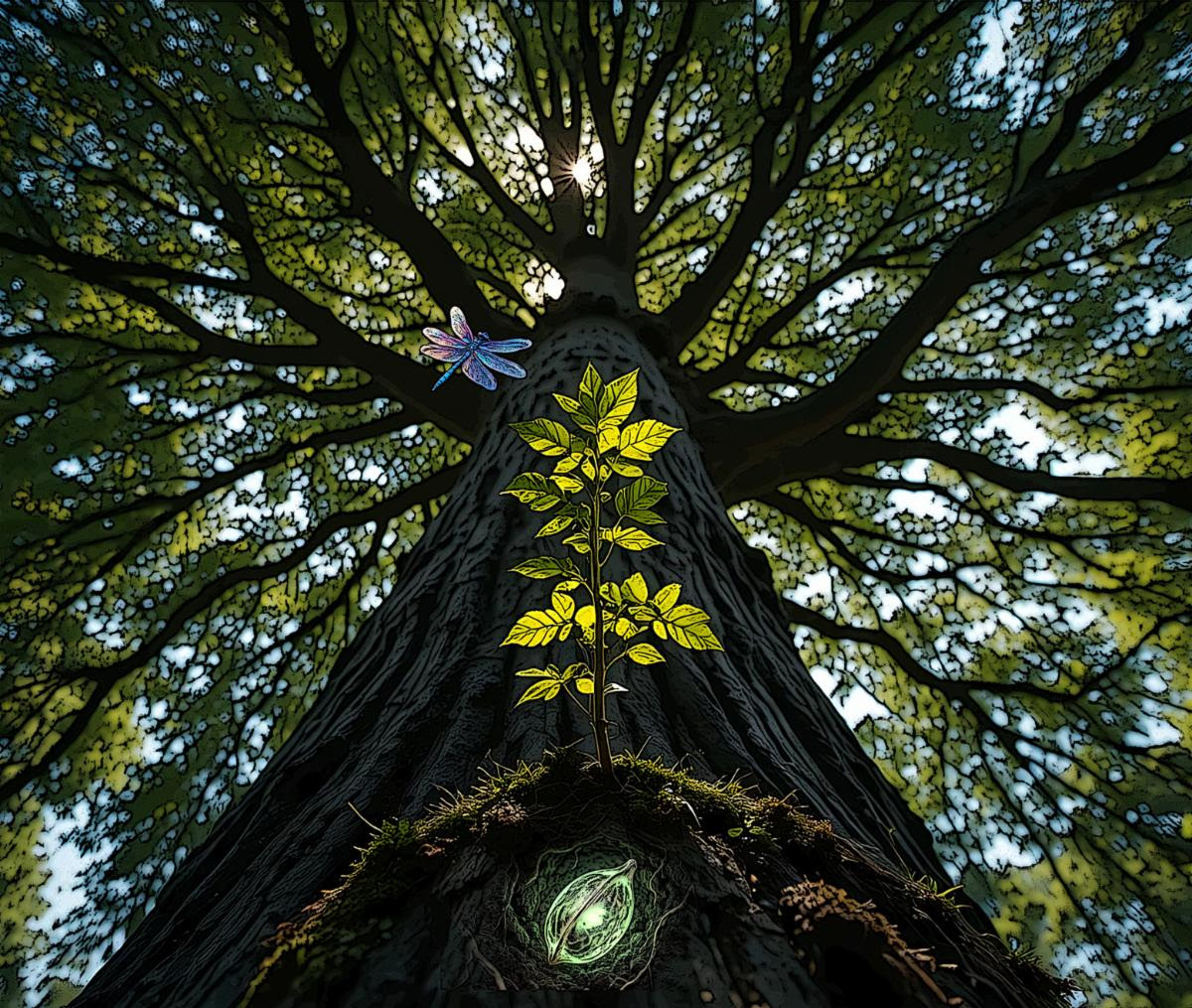
Photo: From Seed to Sky [Collage]. Doug Van Houten
To read previous musings click here.